Eco-Friendly Printer Comparison: Truth Beyond Energy Star Ratings
By Aisha Williams • 3rd Oct
Evaluating commercial office printers requires moving beyond ENERGY STAR certifications to examine real-world sustainability impact. True eco-efficiency combines energy metrics with material lifecycle analysis, waste reduction engineering, and total cost of ownership, particularly for SMBs and mid-market firms managing 20-1,000 employees. Let's dissect key factors separating marketing claims from operational reality.
Key Sustainability Metrics Beyond Energy Ratings
| Factor | Traditional Focus | Advanced Evaluation |
|---|---|---|
| Energy Consumption | ENERGY STAR certification | Idle/peak load variance, heat-free tech adoption [1][2] |
| Material Sourcing | Partial recycled content | Closed-loop plastic % (e.g., >85% body composition) [1] |
| Waste Streams | Toner recycling programs | Cartridge-free systems, component longevity (e.g., ceramic drums) [1][3] |
| Operational Waste | Duplex printing | Default settings enforcement, scan-to-cloud workflows [2] |
ENERGY STAR remains a baseline, but heat-free technologies like Epson's PrecisionCore reduce energy use by up to 85% compared to lasers[1]. Kyocera's long-life components (ceramic drums, developers) demonstrate how hardware durability directly cuts replacement part waste[1].
Commercial Printer Analysis: Performance vs. Green Claims
Canon imageRUNNER ADVANCE DX C3935i Optimized for mid-size offices needing color precision with:
- QF toner that reduces fusing energy
- 85%+ recycled plastic body
- Universal Login Manager that reduces unnecessary prints[1] Monitor: Requires enrollment in Canon's toner recycling for full loop closure.
Epson WorkForce Enterprise AM-C6000 Ideal for high-volume teams prioritizing speed/sustainability balance:
- Cartridge-free Replaceable Ink Pack System (RIPS)
- PrecisionCore Heat-Free Technology (85% less energy)
- EPEAT Gold + ENERGY STAR certified[1][2] Critical note: Ink dependency limits heavy barcode/label applications.
Kyocera TASKalfa 3554ci Durable solution for moderate-volume environments:
- 50,000+ page component lifespans
- AI-driven toner saver mode
- Carbon Offset Program integration[1] Operational tip: Pair with Kyocera's fleet management for supply predictability.
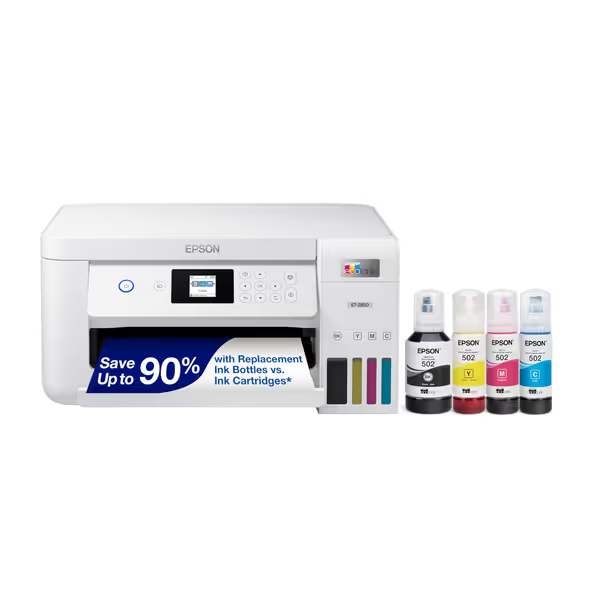
Epson EcoTank ET-2850 Wireless Color All-in-One
Cartridge-free printing slashes ink costs and waste for efficient office workflows.
$263
Ink IncludedUp to 2 years of ink in the box
Ink IncludedUp to 2 years of ink in the box
Pros
Dramatically lower ink costs; cartridge-free design.
Reduces cartridge waste and supply chain headaches.
Cons
Mixed reviews on print quality and connectivity reliability.
Color accuracy may not meet all professional expectations.
Customers find the printer easy to set up and appreciate its cost-effectiveness, noting that the ink is cheaper than cartridge printers. The functionality and print quality receive mixed reviews - while some say it works perfectly and prints clearly, others report it stops working and prints streaky. The connectivity and ease of use also get mixed feedback, with some praising the seamless wireless connection and user-friendly app, while others complain about WiFi connectivity issues and find it extremely complicated to use. The color quality is also mixed, with some finding it good while others note that color printing doesn't match expectations.
Customers find the printer easy to set up and appreciate its cost-effectiveness, noting that the ink is cheaper than cartridge printers. The functionality and print quality receive mixed reviews - while some say it works perfectly and prints clearly, others report it stops working and prints streaky. The connectivity and ease of use also get mixed feedback, with some praising the seamless wireless connection and user-friendly app, while others complain about WiFi connectivity issues and find it extremely complicated to use. The color quality is also mixed, with some finding it good while others note that color printing doesn't match expectations.
The Epson EcoTank ET-2850 exemplifies balanced sustainability without cartridges:
"Each ink bottle set replaces ~80 cartridges, cutting plastic waste by 90% while delivering 7,500 B&W pages per fill." Its Micro Piezo technology eliminates heat requirements while maintaining sharp text quality[3]. For offices printing ~150 pages monthly, this model reduces both consumable costs and maintenance tickets through:
- Auto-duplex enforcement
- Voice-activated workflow integration
- Bottle-fill systems preventing cartridge disposal[3].
Operational Realities: Converting Specs into Ticket Reduction
True sustainability aligns hardware with user behavior: For step-by-step policy ideas that reduce waste and cost, see our sustainable office printing guide.
- Preset configuration: Lock duplex/grayscale defaults to cut color overruns
- Supply chain resilience: Prioritize multi-source toner options (e.g., Kyocera's open supply chain) to avoid backorder-related downtime
- Lifecycle analytics: Track per-device waste metrics (e.g., HP Smart Admin Dashboard) to identify outlier departments[1][2]
Decision tree for procurement teams:
1. Calculate monthly page volume →
 - Under 3K: Epson EcoTank ET-2850 (refillable ink)
 - Over 5K: Kyocera TASKalfa (long-life components)
2. Audit document types →
 - High-color: Canon imageRUNNER ADVANCE
 - Barcode/labels: HP TerraJet toner models
3. Validate firmware policies →
 - Reject vendors blocking third-party supplies
Designing for zero tickets means eliminating configuration variables. Standardize driver interfaces across locations and enforce secure release printing to prevent abandoned outputs, a key waste source[2].
Actionable Next Step: Sustainability Audit Framework
Conduct a 4-point assessment of current fleet:
- Energy: Measure kWh during peak/off-peak using smart plugs
- Waste: Weigh discarded cartridges/outputs weekly
- Cost: Calculate cost/page including service interventions
- User friction: Track helpdesk tickets related to print/scan
Prioritize vendors with:
- Transparent end-of-life takeback programs
- In-firmware supply level alerts
- Scan metadata automation (reducing rework)
Ultimately, genuine eco-efficiency emerges when specs support standardized workflows, not when they look impressive in brochures. As Aisha Williams' helpdesk team proved: Design for zero tickets, and sustainability follows.
Related Articles
Eco Tank Printers That Actually Reduce Commercial TCO
Learn why consumer ink tank systems often raise TCO in commercial fleets due to downtime, clogs, and driver fragmentation - and how standardizing on enterprise laser workflows and supply chains cuts tickets and costs. Get clear criteria for when ink tanks fit and practical alternatives that prioritize uptime, driver stability, and compliance.