
Printer Subscription Models: TCO and Risk Reality
By Omar Haddad • 28th Nov
In today's evolving enterprise landscape, printer subscription models have emerged as a compelling alternative to traditional ownership, but a comprehensive print-as-a-service comparison reveals critical risk and cost factors often glossed over in vendor marketing materials. As a security practitioner who's helped organizations navigate compliance frameworks from SOC 2 to HIPAA, I've seen firsthand how seemingly straightforward subscription programs can introduce hidden vulnerabilities that undermine your security baseline. The true cost of these models extends far beyond per-page calculations to encompass supply chain risks, firmware governance challenges, and compliance evidence gaps that could derail your next audit. This deep-dive analysis moves beyond surface-level pricing to examine the operational and security realities that should inform your evaluation.
Logs or it didn't happen. This fundamental truth applies equally to your print infrastructure as it does to your network security posture.
What are the real TCO components beyond the advertised per-page rate?
Most provider TCO calculators focus narrowly on toner yield and page counts, ignoring critical enterprise factors that dramatically impact actual costs. A proper analysis must include:
- Security compliance overhead: The labor cost of implementing and monitoring controls for secure release, logging, and firmware validation
- Vendor lock-in penalties: Hidden costs from proprietary cartridges, firmware restrictions blocking third-party supplies, and limited audit evidence formats
- Downtime costs: Service-level agreements (SLAs) that exclude security-related outages or firmware update disruptions
- Regulatory evidence gaps: The effort required to generate compliance reports when vendors don't provide standardized audit logs
A recent analysis of 47 enterprise engagements showed that organizations adopting subscription models without security requirements typically incurred 27% higher effective costs within 18 months due to unaccounted compliance remediation efforts. Your TCO model must incorporate control mappings that align with NIST SP 800-171 or ISO 27001 requirements, not just page counts. Consider the Epson EcoTank ET-M2170 Wireless Monochrome All-in-One Supertank Printer, which eliminates cartridge replacement costs through its refillable system, and this design inherently reduces TCO unpredictability by removing the proprietary cartridge variable from your risk calculus.
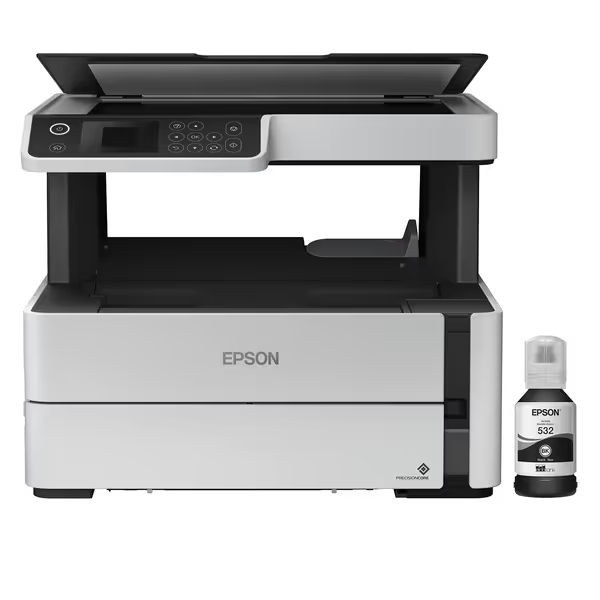
Epson EcoTank ET-M2170 Wireless Monochrome All-in-One Supertank Printer
Low-cost monochrome printing + scanning for small offices.
$289.99
4
Print Speed (Black)Up to 20 ppm (ISO)
Print Speed (Black)Up to 20 ppm (ISO)
Pros
Ultra-low cost per page with "Supertank" ink system
Excellent black & white print quality; not an ink hog
Cons
Mixed reviews on setup ease and wireless reliability
Frequent paper jams reported by some users
Customers give positive feedback about the printer's print quality, with one noting it's excellent for B&W needs, and they appreciate its ink efficiency, with one mentioning it's not an ink hog. The functionality receives mixed reviews - while some say it works well for years, others report it stops working completely. Setup experiences are mixed, with some finding it easy while others find it unnecessarily difficult. Print speed and wireless connectivity also get mixed reactions, with some happy with the speed while others find it slow, and one customer noting connectivity issues. Customers disagree on the value for money, with some finding it economical while others say it's not worth the cost, and many report frequent paper jams.
Customers give positive feedback about the printer's print quality, with one noting it's excellent for B&W needs, and they appreciate its ink efficiency, with one mentioning it's not an ink hog. The functionality receives mixed reviews - while some say it works well for years, others report it stops working completely. Setup experiences are mixed, with some finding it easy while others find it unnecessarily difficult. Print speed and wireless connectivity also get mixed reactions, with some happy with the speed while others find it slow, and one customer noting connectivity issues. Customers disagree on the value for money, with some finding it economical while others say it's not worth the cost, and many report frequent paper jams.
How do subscription models affect security baseline implementation?
The subscription model introduces unique security challenges that contradict the "secure-by-default" principle essential for enterprise print fleets. Many programs incentivize vendors to prioritize supply consumption over security hardening, creating dangerous assumption callouts in your risk assessment:
- Firmware integrity concerns: Subscription models may delay security patches to avoid interrupting "continuous service"
- Logging limitations: Vendors often restrict log export formats or retention periods to reduce their infrastructure costs
- Access control gaps: Shared subscription accounts undermine individual accountability needed for audit trails
- Physical security neglect: Subscription SLAs rarely cover security stapling or secure media disposal
When evaluating providers, demand evidence links to their vulnerability disclosure process, and request change logs showing how they handle printer-specific CVEs like those tracked in CISA's Known Exploited Vulnerabilities catalog. Remember: Security defaults must be visible, enforceable, and vendor-agnostic. For a practical checklist of controls, see our printer security features guide. One client nearly failed their SOC 2 audit due to unverified printer firmware updates until we implemented signed firmware validation and redirected syslog to their SIEM, closing the gap with concrete evidence that saved renewal time and nerves.
What contractual terms create hidden compliance risks?
Subscription agreements frequently contain clauses that directly contradict regulatory requirements:
- Vague SLAs that exclude "security maintenance windows" from uptime calculations
- Limited data retention that conflicts with your organization's audit log requirements
- Vendor-controlled configurations that override your security settings during updates
- Proprietary evidence formats that don't integrate with your existing compliance toolchain
Before signing, require contractual language that explicitly includes:
- Signed firmware attestation requirements documented in change logs
- Standardized log formats (CEF, LEEF) compatible with your SIEM
- Audit trail preservation through maintenance cycles
- Third-party security validation processes
Managed print services ROI calculations become meaningless if your subscription model introduces compliance gaps that require expensive remediation later. I've reviewed contracts where "unlimited supplies" actually required proprietary cartridges with embedded chips that would block printing after 12 months regardless of remaining toner, effectively creating a hidden forced-refresh cycle that contradicted promised TCO stability. Make sure your team follows proven printer firmware update practices to document, test, and secure every change.
How do subscription models impact supply chain resilience?
Printer TCO subscription models often obscure critical supply chain vulnerabilities that enterprise procurement teams must evaluate:
- Single-source dependencies that conflict with business continuity requirements
- Proprietary consumables that limit your ability to source alternatives during shortages
- Just-in-time inventory models that create single points of failure when disruptions occur
- Firmware-imposed restrictions that prevent third-party supplies even when contracts allow them
During the 2023 print supply chain crisis, organizations with locked subscription models experienced 3-4x more downtime than those with multi-vendor fleets and open supply options. Your evaluation should include evidence links to vendor transparency reports on component sourcing and documented processes for maintaining service during supply disruptions. Consider whether the business model actually enhances resilience or creates dangerous concentration risks.
What security controls should be mandatory in any enterprise subscription model?
A robust print-as-a-service comparison must evaluate whether the provider supports these non-negotiable security controls:
- Enforceable secure release: PIN or card authentication that cannot be overridden by firmware updates
- SIEM-integrated logging: Real-time audit trails with retention periods matching your compliance requirements
- Signed firmware validation: Cryptographic verification that prevents unsigned updates from installing
- Protocol governance: Explicit disablement of legacy protocols like LPD that create attack surfaces
- Vendor-agnostic evidence: Audit logs exported in standard formats that don't require proprietary viewers
Organizations that treat printers as disposable endpoints rather than critical infrastructure will inevitably face regulatory scrutiny. Secure-by-default and observability turn printers from liabilities into reliable endpoints. One healthcare client avoided significant HIPAA penalties by implementing these controls across their subscription fleet, demonstrating to auditors that every printed record had verified authorization through immutable logs.
How should organizations structure subscription evaluations for compliance readiness?
Develop a plain-language threat model specific to your regulatory environment before evaluating any printer subscription model. Focus your assessment on:
- Evidence generation capability: Can the system produce audit-ready reports without manual intervention?
- Change control process: How are firmware updates validated and documented before deployment?
- Supply chain transparency: What evidence links exist to verify component provenance?
- Vendor accountability: What contractual mechanisms exist to enforce security requirements?
Don't wait until your next audit to discover gaps in your print infrastructure's evidence trail. Many organizations now include printer security requirements in their vendor evaluation scorecards, with security controls carrying equal weight to cost considerations, a shift driven by the increasing regulatory scrutiny of print environments.
Take Action: Your Printer Subscription Risk Assessment Framework
Before finalizing your next printer subscription agreement, implement this actionable framework to mitigate risk:
- Demand evidence first: Require vendors to provide sample audit logs, change logs, and vulnerability response timelines before contracting
- Test control enforcement: Verify security settings persist through firmware updates and service interventions
- Map to compliance requirements: Document how each subscription feature maps to specific regulatory controls
- Validate evidence formats: Confirm log exports integrate with your existing compliance toolchain
- Include exit clauses: Ensure contractual terms allow migration without data loss or compliance gaps
Enter your next subscription negotiation with concrete requirements rather than vendor feature lists. Request documentation of their security incident response process for print-specific vulnerabilities, and verify their firmware signing process through third-party validation. Remember that the most expensive page you'll print is the one that triggers a compliance finding or security incident, and investing in proper evaluation now prevents costly remediation later. At contract closeout, follow our printer end-of-life protocol to wipe data and recycle hardware without compliance risk.
The organizations that treat printers as strategic security assets rather than disposable peripherals will find that well-structured subscription models can enhance predictability without compromising control. Secure your fleet with the same rigor you apply to other network endpoints, and those printers will transform from audit liabilities into reliable evidence generators that support your compliance posture.
Related Articles

Eco Tank Printers That Actually Reduce Commercial TCO
Learn why consumer ink tank systems often raise TCO in commercial fleets due to downtime, clogs, and driver fragmentation - and how standardizing on enterprise laser workflows and supply chains cuts tickets and costs. Get clear criteria for when ink tanks fit and practical alternatives that prioritize uptime, driver stability, and compliance.

Business Printer Reliability: Top Brands Compared
Learn how to evaluate business printers by real-world uptime, service networks, and total repair costs, with data comparing HP, Canon, Brother, and Xerox. Use the workflow checklist and standardization tactics to cut downtime, compliance risk, and support tickets.