
CIS vs CCD Scanners: Lifetime Costs and Office Workflows
By Priya Natarajan • 7th Mar
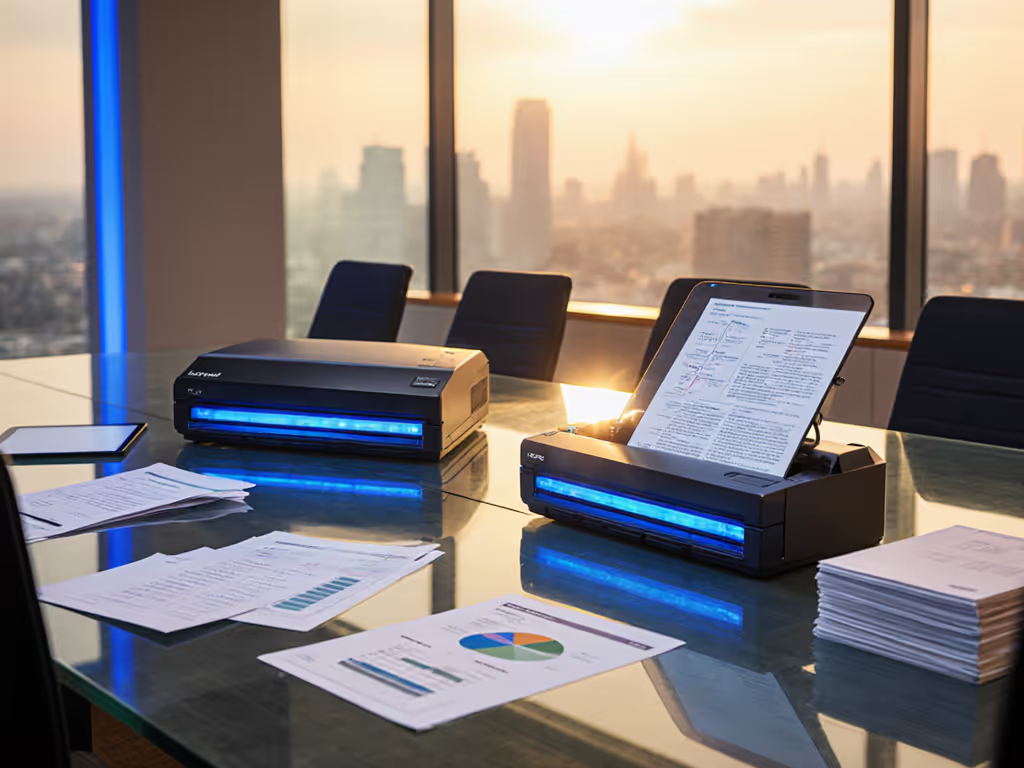
Choosing between office scanner printer technologies hinges on a single question that most purchasing teams get wrong: What's the total cost over five years? For a rigorous methodology to model five-year expenses, see our total cost of ownership guide. Not the upfront invoice. Not the glossy spec sheet. The real cost means consumables, maintenance, downtime, supply disruptions, and the hidden fees that surface when demand spikes or a sensor fails on a Tuesday at 2 PM. When you model it honestly, the cheaper entry price often isn't the cheaper choice.
CCD and CIS are the two dominant ADF sensor technology approaches in large-format office environments, and they behave radically differently under real-world pressure. If you're comparing throughput and capture accuracy, review our ADF scanning & OCR guide. Understanding their line-item breakdowns, especially across a 3-5 year contract term, is the difference between a predictable budget and a procurement scramble every quarter.
The Technology: What You're Actually Buying
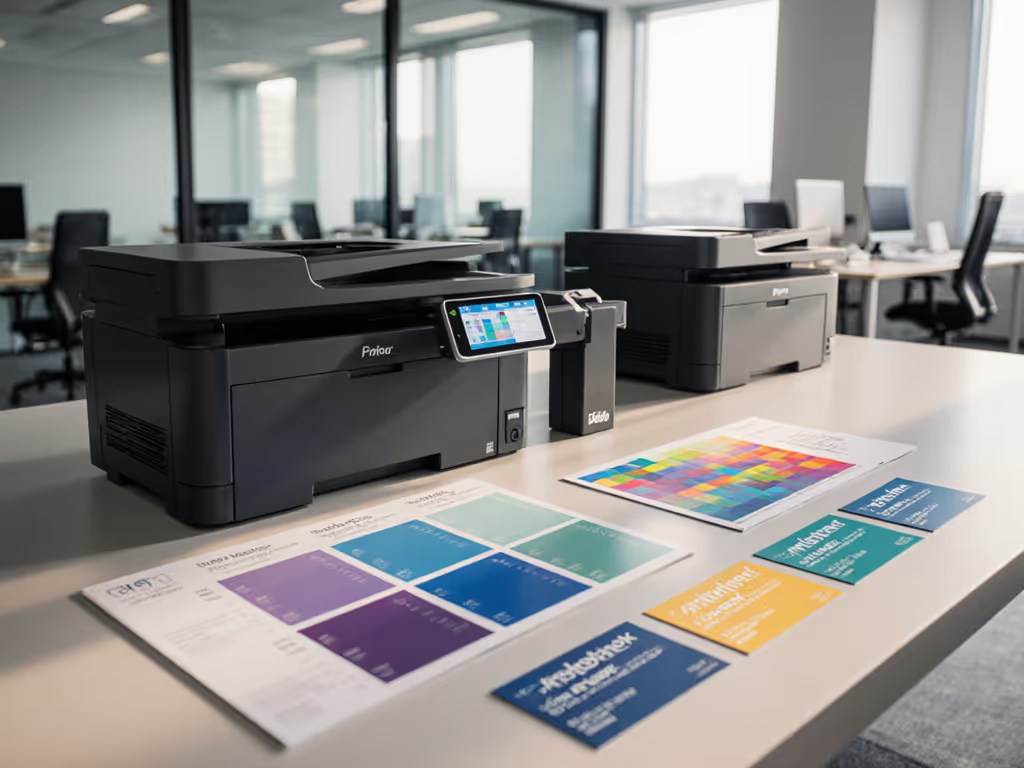
CCD (Charge-Coupled Device) scanners use camera-based optics, a separate lens, and a sensor array positioned below the scanning surface. This architecture allows CCD to capture up to 48-bit color information and maintain sharp focus even when documents aren't perfectly flat. CCD sensor arrays can handle mounted originals up to 0.60" thick (critical if you're scanning archived drawings, folded blueprints, or textured artwork). The technology also supports face-down scanning with USB 3.0 file transfer, reducing transfer wait times between jobs. For bottleneck-free transfers across USB, Ethernet, and Wi-Fi, see our office connectivity deep dive.
CIS (Contact Image Sensor) technology uses a linear array of fiber optic lenses positioned directly under the glass, paired with red, green, and blue LEDs. The image sensors sit immediately adjacent to the document surface, which is why CIS scanners are compact and lightweight. However, this architecture requires direct contact and sharp focus, so slight wrinkles, thickness variation, or raised surfaces produce blur.
On paper, CIS sounds like a win for space-constrained offices. But contract language matters: what seems cheaper upfront rarely accounts for scenario analysis around real volume, document types, and supply continuity. Before signing, weigh leasing vs buying trade-offs to understand long-term cost exposure.
Line-Item Cost Breakdown: Sticker Price vs. Total Cost
Initial Equipment Cost
CCD scanners carry a higher upfront tag (typically 40-60% more than CIS models) because the camera optics, lens assembly, and calibration requirements are more complex and expensive to manufacture. CIS technology uses simpler electronics and no moving optics, which is why vendors can price them lower.
Consumables and Replacement Parts
Here's where scenario analysis becomes essential. CCD scanners are more robust; because manufacturers invest more in paper handling and mechanical design, they typically see fewer feed jams, sensor misalignments, and early failures. CIS scanners are sensitive to focus depth and LED drift over time. If you're scanning 50,000+ pages per year, a CIS scanner experiencing LED degradation or a focus calibration drift will produce rejects and rework (invisible costs that don't show up in the purchase order).
Maintenance kits, sensor cleaning supplies, and LED replacements for CIS models may be cheaper per unit, but CIS devices can consume consumables faster under high-volume stress. CCD systems, by contrast, operate more predictably under load.
Service Calls and Downtime
This is where continuity planning separates the pros from the problems. Build resilience with our printer disaster recovery checklist. CCD scanners, with their deeper design, tend to have longer mean time between failure (MTBF) figures. More importantly, they support better predictability in SLA terms. A CIS scanner that requires recalibration every 18 months, or a replacement LED array after 3 years, isn't reflected in the lease rate, but it is a service call that halts scanning workflows.
Most procurement teams miss this in contracts: a mid-tier lease with a $150/month service fee and 4-hour response time is often cheaper over five years than a low-price CIS unit bundled with a vague support commitment or undefined response window.
Related Articles