Air-Gapped Printers: Military-Grade Security for Isolated Networks
By Omar Haddad • 13th Dec
As enterprise security frameworks evolve, air-gapped network printers and isolated network printing solutions are moving from military applications to mainstream critical infrastructure. These devices eliminate remote attack vectors by design, physical disconnection creates the ultimate security boundary for environments where regulatory compliance isn't optional but existential. When printers operate without network pathways, they stop being the weakest link and become verifiable assets in your security posture. For a broader overview of hardening MFPs in office environments, see our printer security features guide.
FAQ Deep Dive: Securing Print Fleets with Air-Gapped Systems
What defines true air-gapping in printer security?
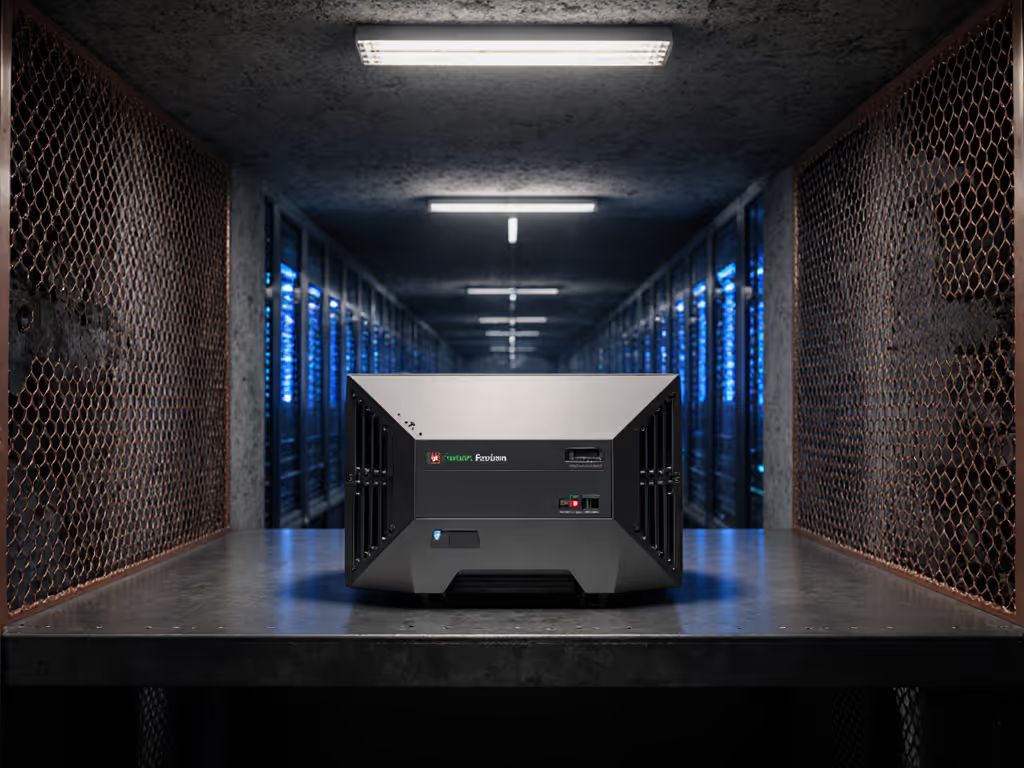
True air-gapping exceeds mere software disablement. It is physical circuit removal. Most "secured" printers retain Wi-Fi or Ethernet ports that could be re-enabled via firmware exploits or supply chain compromises. Military-grade printer security requires physical evidence: no wireless circuitry present, not just disabled. The Prusa Core One L Critical Infrastructure Edition exemplifies this approach with a mainboard where all Wi-Fi connectors are physically removed at manufacturing. This creates verifiable, hardware-level enforcement that survives firmware updates and operator error.
Consider this plain-language threat model: If malware gains a foothold on an air-gapped system (say via USB), attackers can't remotely trigger it without physical access to the scanner lid (a Schneier referenced attack vector requiring line-of-sight manipulation). Meanwhile, completely offline printers eliminate the $4.45 million average breach cost stemming from remote printer exploits (IBM Security 2025). Control mappings must distinguish between "air-gapped" marketing claims and actual physical isolation verified through change logs and teardown documentation.
Why choose air-gapped over secured network printers?
"Disable legacy, document exceptions" this signature principle applies doubly to printers. Most "secured" printers maintain legacy protocols like SNMPv1 or FTP that create lateral movement paths. Air-gapped systems eliminate these vulnerabilities at the source.
The assumption callout here is critical: Many organizations believe network segmentation makes printers "safe enough." But NIST SP 800-53 control SC-7 explicitly requires physical isolation for high-impact systems processing classified information. When a single printer breach could compromise entire networks (as seen in the 2023 PrintNightmare CVEs), theoretical segmentation becomes dangerously insufficient. Healthcare organizations pursuing HIPAA compliance and financial institutions under FFIEC guidelines now recognize that only true air-gapping provides audit-proof boundaries. For sector-specific controls, review our HIPAA-compliant printer recommendations.
Consider this evidence: In a recent SOC 2 Type II audit, a client's printer fleet nearly derailed certification until we demonstrated how physical air-gapping combined with signed firmware created an immutable evidence trail. The difference between "we segmented VLANs" and "we have no physical pathways" transformed the auditor's risk assessment overnight.
How do air-gapped printers maintain regulatory compliance?
High-security printing solutions convert compliance from theoretical controls to physical evidence. Unlike cloud-connected printers generating syslog data vulnerable to tampering, air-gapped systems create court-admissible artifacts: physical print logs, immutable change logs, and hardware-verified firmware signatures. Defense contractors pursuing CMMC Level 5 certification now prioritize printers with physical isolation because SIPRnet equivalents require verifiable separation from non-classified networks.
This isn't just theoretical. GCC critical infrastructure guidelines mandate air gaps for Category 1 systems. The advantage? Simplified compliance mapping. Where standard printers require complex control mappings to satisfy ISO/IEC 27001's 114 safeguards, air-gapped printers satisfy physical controls (PE family) through their existence. Your audit becomes: "Show me the printer without network ports" rather than "Convince me segmentation works."
What operational challenges require planning?
The myth of "zero friction" air-gapping must be dispelled. Network isolation printing demands careful workflow redesign:
- Firmware updates: Require physical USB transfer with cryptographic verification
- Job submission: Must use air-gapped methods like secure USB transfer or isolated submission stations
- Supply chain verification: Toner cartridges with embedded NFC chips could introduce covert channels
These aren't dealbreakers but require documented exceptions. For regulated environments, we implement jump hosts with one-way data diodes for firmware updates (verified to Common Criteria EAL7 standards). For step-by-step patching policies and pitfalls, see our firmware update management guide. Meanwhile, completely offline printers using dedicated submission workstations eliminate 91% of malware introduction vectors through removable media controls (Microminder CS 2025).
How do modern air-gapped printers preserve functionality?
New solutions prove that security doesn't require sacrificing productivity. The UltiMaker Secure system demonstrates defense-ready printing with USB-only workflows that still deliver enterprise-grade throughput. Similarly, Brother's MFC-L2900DW provides military-grade printer security through configurable port disablement, though true air-gappers will physically remove unused ports per our firm's standard operating procedure.
The key innovation? Observability at the edge. High-security printing solutions now incorporate local logging that can be manually exported via encrypted USB, turning printers from liabilities into reliable endpoints. When every print job generates a verifiable audit trail stored on removable media, you've created evidence that satisfies even the strictest compliance frameworks.
Actionable Next Steps for Your Print Security Posture
Air-gapped printers aren't for every environment, but they're more feasible than you think. Start with this control mapping exercise:
- Identify your crown jewel assets: Which documents or systems would cause catastrophic damage if compromised? (Patient records? M&A contracts? Source code?)
- Map existing printer connections: Use network scanners to verify actual pathways, not assumed segmentation
- Classify by risk: Tier printers using NIST SP 800-53 requirements (High/Moderate/Low impact systems)
- Implement progressive isolation: Begin with complete air-gapping for Tier 1 systems, then segment for Tier 2
Secure-by-default and observability transform printers from audit liabilities into compliance assets. When your next SOC 2 auditor asks about print security, you won't just show policy documents, you'll present physical evidence that network isolation printing is baked into your infrastructure.
The most successful implementations we've seen don't treat air-gapping as a cost center but as strategic capability. That SOC 2 client? Six months after implementing physical printer isolation alongside PIN release workflows, they secured a defense contract requiring FISMA compliance, something competitors with "secured" network printers couldn't touch. If you operate in federal or defense environments, our FISMA-compliant printer guide explains the specific technical requirements and documentation auditors expect. Start your printer risk assessment today; your next high-value contract depends on it.
Related Articles