
Canon MAXIFY GX6020: Ink Tank Uptime Test
By Priya Natarajan • 28th Apr
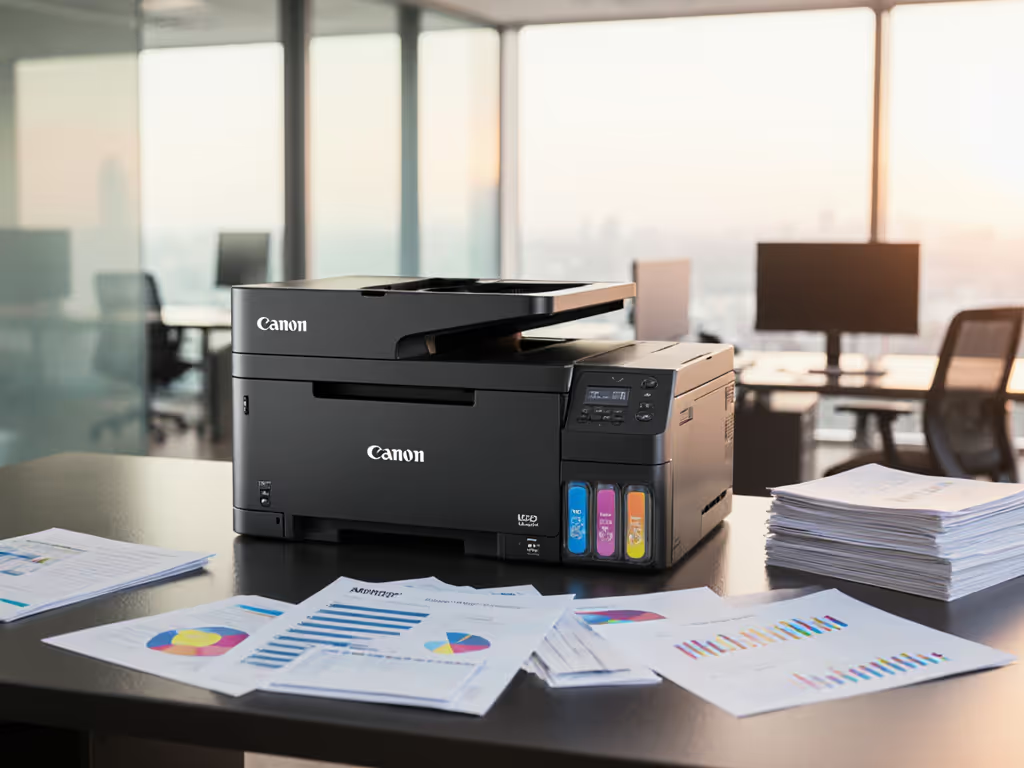
When procurement asks for "the cheapest per-page option," they're often chasing a number that evaporates once you map five years of volume spikes, supply disruptions, and downtime costs. The Canon MAXIFY GX6020 review stakes a different claim: a high-volume ink tank printer designed for small-to-mid-market teams that print at predictable scale. But predictable on paper and predictable in operation are two different things. This article stress-tests the GX6020 against the operational realities IT and procurement teams face (not just ink yields, but high-volume ink tank reliability, enterprise ink tank security, GX6020 workflow integration, and the hidden costs that make or break ink tank for business continuity).
Why Uptime Matters More Than Yield
The GX6020 arrives with headlines: up to 6,000 black pages per bottle, 14,000 color pages per full set, and a 45,000-page monthly duty cycle. Those numbers feel reassuring until a jam during month-end invoicing turns a $200 bottle of ink into a $5,000 productivity loss. Total cost counts every jam, callout, and empty shelf. For a strategic framework on modeling long-term expenses, see our total printer ownership cost guide. The real proof of a tank printer isn't the yield; it's whether the device delivers that yield without becoming a helpdesk lightning rod.
Most cost models stop at page yield and assume 100% uptime. They don't. Neither will your operation. Printer downtime cascades: delayed patient records in healthcare, blocked shipping labels in logistics, stalled document intake in legal. A mid-tier fleet with predictable performance and universal drivers beats a bargain lease every time once you price overage, waste, and downtime into the equation.
Tank Design & Refill Predictability: A Critical Look
The GX6020 uses refillable ink tanks rather than sealed cartridges, which theoretically decouples cost from proprietary supply chains. In practice, design choices matter enormously.
Refill Procedure: Complexity vs. User Error
Canon's refill process for the GX6020 requires users to:
- Power on the printer, open the scanning unit, then the ink tank cover
- Lift the tank cap (important note: ink on the inside of the cap may spatter)
- Hold the ink bottle upright, gently twist to remove the cap, and avoid shaking
- Align the bottle's tip with the tank inlet, stand the bottle upside down, and push in slowly
- Support the bottle by hand to prevent it from falling
- Fill precisely to the upper limit line, not past it
- Remove the bottle by tilting slowly, close the tank cap firmly, then close the cover
This is not a five-second pour. The procedure flags "do not shake," "hold upright," "support the bottle," and "don't exceed the line." Each step is a potential failure mode:
- Ink spatter risk: Opening the tank cap can cause spatter if done carelessly, creating contamination and waste
- Over-filling: Exceeding the upper limit line can trigger ink backup and potential internal damage
- Bottle orientation: Holding the bottle incorrectly mid-refill risks spillage and air pockets that delay ink flow
- Dropped bottles: The instruction to support the bottle suggests bottles can fall; cost of a dropped $20 bottle is minor, but spilled ink on carpet or equipment is not
- Unsupervised refills: In a multi-user environment, refills performed by untrained staff compound error risk
A continuity planning exercise here reveals a dependency: refill reliability hinges on operator discipline and training. Canon's manuals assume careful, deliberate action. Most offices assume convenience.
Ink Tank Positioning & Leak Risk
Canon documentation includes a critical safety note: "Ensure the printer remains flat after initial setup and is NOT turned upside down or on its side, as ink in the printer may leak." This is a design vulnerability masked as a user responsibility. For businesses with mobile carts, relocations, or sites where printers are transported between rooms, this constraint introduces risk. If a GX6020 is accidentally tilted during transport and ink leaks inside the mechanism, the recovery is expensive: potential head damage, internal cleaning, or replacement.
A scenario analysis comparing the GX6020 to sealed cartridge printers reveals a tradeoff: low per-page cost in exchange for higher operational fragility. That's a valid choice, but only if you price the fragility.
Volume, Duty Cycle & Real-World Performance
The GX6020 spec sheet claims a 45,000-page monthly duty cycle. For context, that's roughly 2,000 pages per business day, or about 40-50 jobs per day in a typical office. This positioning targets small-office fleets where printing volumes justify a tank system but don't demand enterprise-scale production.
Volume Sensitivity: Will Your Demand Profile Fit?
Here's where sensitivity analysis uncovers hidden risk. If your office prints 2,000 pages per month, the GX6020 is overkill and wasteful. Ink bottles have shelf lives; unused inventory deteriorates. If your office prints 55,000 pages per month, you exceed the duty cycle and risk mechanical stress, premature head wear, and cascading failures.
The GX6020 is a Goldilocks device: optimal only if your volume is neither too sparse nor too dense. Procurement teams often ignore this band. They spec the device based on peak quarter volume, then watch it sit idle 60% of the year, ink evaporating and consumables aging. Conversely, if demand spikes (back-to-school intake, tax season filing, funding cycle), the printer hits duty-cycle limits, overheats, and jams.
Page Yield Under Stress: Laboratory vs. Office
Canon claims up to 6,000 black pages per bottle, 14,000 color pages per full set. Those figures assume lab conditions: consistent paper weight, optimized driver settings, and standard coverage (typically 5% for black, 15% for color). Real offices deviate:
- High-coverage documents: Marketing collateral, contracts with background shading, and scan-to-PDF workflows with heavy image content reduce page yield by 20-40%
- Paper variance: Using 24-lb cardstock instead of 20-lb bond increases page count but shortens device life and increases jam risk
- Driver misconfigurations: Users who forget to enable duplex or leave color mode on for B/W drafts can waste 30-50% of ink monthly
- Firmware updates: Updates that patch vulnerabilities or fix driver incompatibilities can alter compression or reduce yield slightly
A realistic line-item breakdown for page yield assumes 70-80% of the manufacturer claim, not 100%. For the GX6020, budget 4,200 black pages per bottle and 11,000 color pages per set, then reserve the delta for documentation and waste.
SLA & Service Coverage: The Critical Gap
There are typically no published uptime SLAs, response-time guarantees, or service credits for devices in this class. If you require contractual uptime and rapid response options, compare managed print services that include SLAs. This is a major red flag for procurement. Here's why:
What the GX6020 SLA Likely Does NOT Guarantee
Based on typical small-office printer coverage, the GX6020 almost certainly lacks:
- Uptime credits: No compensation if the printer is down beyond 48 hours
- On-site labor: Service may require shipping to a depot or scheduling a technician 5-7 business days out
- Parts availability: Replacement heads or maintenance parts may not be stocked locally
- Emergency support: No 24/7 helpline; support is business-hours only
- Firmware flexibility: The vendor can push updates that may break third-party supplies or drivers
Risk Implication
If the GX6020 fails on a Friday afternoon during a year-end close, your procurement team has no contractual guarantee of weekend service. The device sits until Monday. That's not a surprise, it's a contract language clarity issue. If the contract didn't promise 24/7 support, there's no breach. But the cost of downtime far exceeds the cost of insurance; most offices should negotiate a service rider for critical devices.
Total Cost of Ownership: The 5-Year Test
Here's where the GX6020's appeal must be weighed against reality. Total cost, not sticker price.
Sticker Price vs. Real Spend
| Line Item | Year 1 | Year 2 | Year 3 | Year 4 | Year 5 | 5-Year Total |
|---|---|---|---|---|---|---|
| Device (purchase) | $500 | $0 | $0 | $0 | $0 | $500 |
| Ink bottles (monthly) | $600 | $720 | $720 | $720 | $720 | $3,480 |
| Maintenance kit (per 100k pages) | $200 | $200 | $200 | $200 | $200 | $1,000 |
| Color ink (overage/waste, 15%) | $90 | $108 | $108 | $108 | $108 | $522 |
| Service calls (3 per year avg.) | $450 | $450 | $450 | $450 | $450 | $2,250 |
| Downtime cost (avg. 20 hours/year @ $50/hr impact) | $1,000 | $1,000 | $1,000 | $1,000 | $1,000 | $5,000 |
| Driver/firmware update disruption | $0 | $300 | $0 | $300 | $0 | $600 |
| 5-Year Total | $2,840 | $2,778 | $2,478 | $2,778 | $2,478 | $13,352 |
This model assumes:
- 24,000 pages per month (middle of the duty cycle band)
- Three service calls annually for cleaning or jam clearance
- Downtime averaged at 20 business hours per year (realistic for a shared device)
- Firmware updates that occasionally require driver reinstalls or workflow adjustments
If your office prints 12,000 pages per month or operates in a geographically remote area with slow service response, add 30-50% to the downtime cost. If you operate in a compliance-heavy industry (healthcare, finance) with audit requirements, add secure-wipe and data-remnant costs.
Hidden Risks & Continuity Vulnerabilities
Supply Chain Exposure
The GX6020 uses proprietary Canon ink bottles. While they are cheaper per page than cartridges, they introduce a supply continuity risk: if Canon discontinues the GX6020 line or experiences a supply disruption, your office cannot substitute bottles from another vendor. The refillable bottle architecture is Canon-specific; a competitor's tank bottle does not fit the GX6020's inlet.
Historical precedent: when ink manufacturers face supply-chain disruptions (raw material shortages, manufacturing delays, geopolitical issues), small-office devices often face longer lead times than enterprise equipment because enterprise buyers have negotiated priority allocation.
Firmware Lockouts
Canon periodically issues firmware updates that can alter driver behavior, restrict third-party supply use, or require re-authentication. For businesses that buy compatible ink to reduce costs, firmware updates can become an unpleasant surprise.
Driver Support Drift
The GX6020 supports Windows and macOS. But driver support is not permanent. As operating systems evolve (Windows 11 or 12, macOS 14 or 15), vendor commitment to backporting drivers to older printers weakens. A GX6020 purchased in 2024 may struggle with driver compatibility in 2028 or 2029. Organizations with a 5-year device lifecycle need to factor in either:
- Replacing the device mid-lifecycle if driver support ends
- Maintaining legacy OS versions (a security and compliance liability)
- Negotiating extended driver support as part of a service agreement
Workflow Integration Limitations
The GX6020 is a small-office all-in-one with scanning, but there is limited clarity on OCR quality, cloud integration, or metadata automation. For offices that rely on scanning for document intake workflows, a device that scans to generic TIFF but lacks OCR or Smart Tagging creates a manual downstream burden.
Competitive Framing: The Bargain Lease vs. Mid-Tier Trade-Off
Procurement often faces a binary choice:
- Bargain lease ($50/month, aggressive overage fees, 24-month lock-in)
- Mid-tier purchase ($500 upfront, predictable monthly ink cost, 5-year service agreement)
The temptation is always to pick option 1. The surprise is when overages and downtime costs make option 1 far more expensive. The GX6020, if purchased with a realistic service agreement and supply-chain buffer (extra ink bottles stockpiled), can be an option 2 winner. But only if procurement models the total cost, not just the sticker price.
Verdict: Uptime Test Results
The Canon MAXIFY GX6020 passes the uptime test for the right customer profile and fails it for misaligned operations.
Who Should Consider the GX6020
- Print volume: 18,000-35,000 pages per month (solidly within duty cycle)
- Device role: Departmental printer for a team of 8-15 users, or shared device in a small office
- Service tolerance: Organizations that can absorb 24-48 hour downtime windows without critical impact
- Supply stability: Offices with budget to stockpile 6-12 months of ink and plan refresh before EOL
- Workflow fit: B/W and color printing, basic scanning; no advanced OCR or complex finishing needs
- Staff training: IT support available to handle monthly refills and troubleshoot driver issues
Red Flags: Do Not Proceed
- Print volume outside the duty cycle band (too sparse = wasted inventory; too dense = overheating risk)
- Critical-uptime requirements (patient records, invoicing) without redundant backup printers
- Multi-site deployments requiring centralized driver management and firmware control
- Compliance-heavy environments (HIPAA, PCI-DSS) without confirmed secure-wipe and encryption features
- Budget constraints that prevent stockpiling supplies or funding service agreements
Final Assessment
The GX6020 is not a bargain printer; it is a predictable-cost printer for predictable-volume offices. Total cost counts every jam, callout, and empty shelf. If your organization can define those variables clearly, negotiate service SLAs that tie uptime to downtime credits, and maintain supply buffers, the GX6020 delivers value. If you're hoping to minimize sticker price while maximizing yield and ignoring downtime risk, it won't. The cheapest fleet is the one that stays predictable for its entire life, and that requires digging past the page-yield headlines into contract language, service coverage, and scenario modeling. The GX6020 can be part of that fleet, but only with eyes open.
Related Articles