
Ink Tank vs Color Laser: True TCO for Small Offices
By Priya Natarajan • 27th Mar
When a small office procurement team asks whether to deploy ink tank or color laser printers, the conversation rarely starts where it should: a five-year total cost model. Instead, it begins with a glance at unit price. That gap between sticker price and lifetime cost is where predictability dissolves and budgets fracture. For a full framework, see Total Printer Ownership Cost Guide.
Ink tank and color laser printers occupy fundamentally different cost zones, but not always in the direction your first quote suggests. Choosing between them requires scenario analysis grounded in your actual volume, supply chain risk tolerance, and maintenance exposure. This guide builds the framework that separates true cost from marketing narrative.
The Headline Numbers: Why Sticker Price Misleads
Ink tank printers typically cost $200 to $1,000 depending on feature set and duty cycle. If 'duty cycle' is unclear, see Printer Duty Cycle Explained for practical capacity planning. Color laser printers occupy a similar band but pull you toward different long-term commitments. A modest printer might seem cheaper upfront, but upfront cost is not a budget line (what follows is).
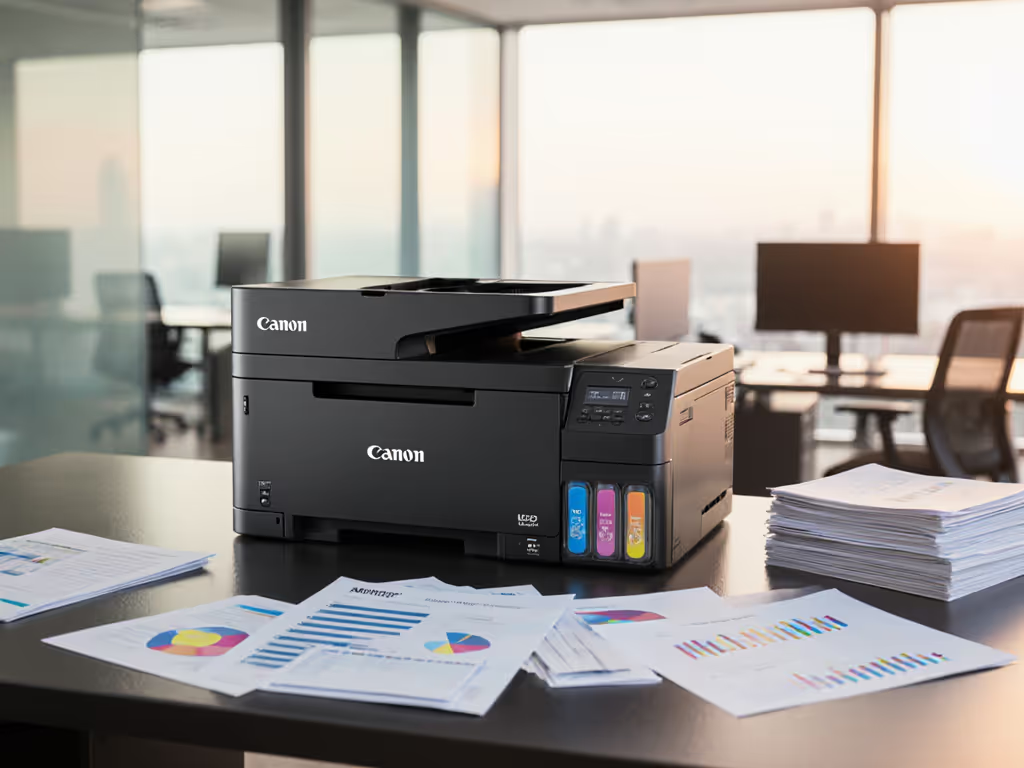
The critical difference: ink tank systems ship with up to three years of ink included, allowing users to print approximately 8,000 color pages before purchasing refills. Some high-yield ink bottles deliver print counts as high as 14,000 pages per color bottle, pushing cost-per-page below two cents. By contrast, color laser printers demand fresh toner cartridges and replacement parts (fuser, drum unit, transfer roller) on predictable intervals tied to duty cycle and volume.
For a small office averaging 500 pages per month in color, that upfront supply cushion matters. For one printing 2,000 pages monthly, it evaporates quickly. The real question is not which printer costs less today, but which one locks in predictable costs across 36 to 60 months of operation.
Volume Thresholds: Where Each Technology Wins
No universal rule holds. Instead, model your scenario. For a deeper technology comparison grounded in costs, read Inkjet vs Laser: Real Cost Analysis.
Light Volume (Under 300 Pages/Month): A modest black-and-white laser printer remains difficult to beat. Toner cartridges stay stable on the shelf, machines are reliable with infrequent servicing, and per-page costs on monochrome remain competitive. If color is rare, ink tank systems saddle you with depreciation on equipment sitting idle most of the time.
Moderate Volume (300-1,000 Pages/Month Mixed Color/B&W): Ink tanks begin to show advantage. The initial three-year ink supply absorbs the first 24 months of typical demand in many small office environments. Color output does not trigger cascading toner cartridge purchases or fuser replacements. Laser color printers, by contrast, generate both higher consumable costs and earlier replacement-part wear, particularly on the fuser assembly and imaging drum (components that color printing accelerates).
High Volume (Above 1,000 Pages/Month): Laser printers regain ground, but context determines the winner. If your output skews monochrome (invoices, contracts, compliance documents), a high-speed black-and-white laser with low cost-per-page is difficult to argue against. If color represents 30% or more of output, the total cost model often favors ink tank systems unless your volume is so high that a high-end production laser becomes justifiable.
Supply Chain Resilience: The Hidden Risk Factor
Here is where most TCO analyses stop short. Continuity is a budget line. When toner runs out or a critical part fails, the cost is not just the replacement, it is the hour your legal office cannot scan documents into your practice management system, or your billing department cannot invoice. That downtime cascades. Reduce unplanned outages with our Printer Maintenance Guide.
Ink tank systems present a different exposure profile. You refill from bottles you stock, not from a single-source cartridge supply chain. If your supplier encounters backorder conditions or firmware updates block third-party supplies, you have fewer options and higher switching costs. Laser printer toner is more commoditized; multiple brands compete, and shelf life of powder cartridges is longer than liquid ink.
For small offices relying on a single printer or a small fleet, ask yourself:
- Can you tolerate a 48-hour supply wait if ink runs out unexpectedly?
- Do your consumable suppliers maintain local stock, or do they drop-ship from centralized hubs?
- What is the firmware update policy? Will new versions block third-party supplies or legacy drivers?
- Is there a single point of failure - one machine supporting multiple teams?
If downtime risk is acute, the "cheaper" option may not be the wisest. A mid-tier ink tank system with proven multi-source supply and a simple driver stack often beats a bargain-basement option that forces a workaround sprint when it fails.
Operational Cost Breakdown: Line-Item Clarity
Building a true cost model requires granularity. Here is where procurement teams often stumble: they assume a few headline numbers will tell the story. Instead, itemize every recurring and contingent expense, then map it to your real volumes and timelines. Consumables, maintenance parts, service calls, energy, and downtime exposure belong in the same worksheet.
Related Articles